Blogs | Steelstrong Valves

7 Best Chain Adjusters for Global Buyers

Choosing a Chain Adjuster is about more than finding a part that fits a catalog photo. Small differences in slot length, bolt position, thread size, and plate thickness can affect installation and chain alignment. A few millimeters matter. For global buyers, unclear drawings or incomplete specifications can turn a routine order into a costly delay.

This guide compares seven chain adjusters for different purchasing needs, from everyday motorcycle maintenance to demanding equipment applications. It considers adjustment range, material, surface finish, mounting compatibility, and the quality of product information. A zinc-coated steel part may suit one environment, while stainless steel or a heavier design may be more appropriate elsewhere. Check the actual operating conditions. Salt spray, mud, frequent vibration, and repeated adjustments all change what “durable” means.

Price matters, but it is only one part of the comparison. Buyers should also review dimensional drawings, inspection details, packaging, order quantities, and available customization. Ask suppliers how they verify critical measurements; a clear answer is more useful than a broad durability claim. Some listings still leave important details unstated. That deserves a second look. No single option fits every machine, budget, or supply chain, and this overview cannot replace checking the manufacturer’s specifications against your application. Use it as a practical shortlist, then confirm fit and material before placing an order.
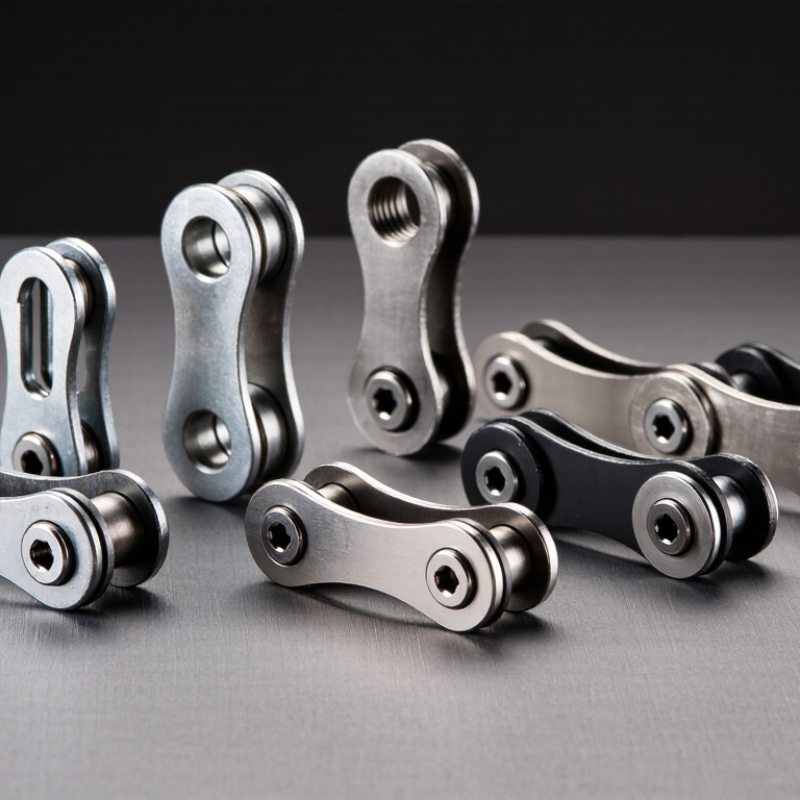
7 Best Chain Adjusters for Global Buyers

Define Seven Chain-Adjuster Types by Drive System, Pitch, and Application

Chain adjusters differ by drive layout, chain pitch, and available mounting space. A small pitch mismatch can create poor sprocket engagement, even when the tensioner fits. Seven common types serve distinct jobs.

Threaded axle adjusters move a rear wheel along slotted dropouts, making them common on motorcycles and single-speed bicycles. Cam adjusters use shaped plates to shift the axle; they are quick to set, but alignment marks can be hard to read. Eccentric hub adjusters rotate an offset axle or bottom-bracket shell, often where frame slots are unavailable. They need compatible frames and careful clamping.

Sliding motor-base adjusters move an electric motor to tension industrial roller chains. Screw take-up frames guide conveyor shafts and suit heavier loads, though they require room for travel. Spring-loaded tensioners maintain contact as chains wear, often in compact or changing-load drives. Idler-sprocket adjusters redirect a chain around a movable toothed wheel; tooth profile and pitch must match the chain. Small details matter.

For buyers, verify the chain standard, pitch, roller width, load, adjustment range, and mounting dimensions. Check whether the system needs manual retensioning or automatic compensation. A catalog image rarely shows clearance around guards or nearby parts. That part gets overlooked. Measurements from the actual assembly are more reliable than a generic fit label, and even then, installation may reveal a constraint the drawing missed.

Verify Fit Against ISO 606, Including 12.7 mm (0.5 in) Chain Pitch

7 Best Chain Adjusters for Global Buyers

Choosing among chain adjusters starts with confirming the chain, not the product listing. ISO 606 covers roller-chain dimensions, but a stated 12.7 mm (0.5 in) pitch alone does not prove compatibility. Check the chain series, roller diameter, and inner width against the sprocket and adjuster specifications. Small differences can cause poor engagement or uneven wear. Measure twice.

For global purchases, compare dimensions in both millimetres and inches, and confirm whether the supplier lists nominal or measured values. Also check the adjuster’s travel range, mounting-hole spacing, load rating, and material. A unit may fit the frame but offer too little movement to compensate for chain stretch. That detail is easy to miss, even with a clear drawing.

Tips: Before ordering, measure several chain links with calipers and verify the sprocket tooth profile. Ask for a dimensioned drawing when specifications are incomplete. If the chain pitch matches but other dimensions remain uncertain, pause and confirm them; pitch is only one part of fit.

Compare Corrosion-Test Evidence from ISO 9227 Salt-Spray Testing

For global buyers comparing chain adjusters, ISO 9227 salt-spray reports offer useful corrosion evidence. The standard sets controlled procedures for exposing samples to a salt-containing mist. A credible report identifies the test method, exposure duration, sample preparation, and inspection criteria. Test hours alone tell little. Ask whether the tested adjuster matches the production finish and material, not just its general product category.

Compare what happened after exposure. Look for photographs, visible red rust, blistering, coating loss, and corrosion around threads or cut edges. These details matter because adjusters are handled and repositioned during maintenance. A clean flat panel may not represent a threaded component. That gap deserves attention. Check whether results describe one sample or repeated specimens, and whether the report comes from a qualified testing laboratory.

Salt spray is a comparison tool, not a service-life forecast. It cannot reproduce every mix of road spray, drying, abrasion, and storage conditions. I would treat unusually strong claims cautiously if the test setup is missing. For a fair shortlist, compare equivalent materials and finishes under the same ISO 9227 method. Then weigh the evidence alongside fit, adjustment range, and documented quality checks. A neat report helps, but it is not the whole story.

Check Fastener Strength Classes Against ISO 898-1

When comparing chain adjusters for international purchasing, check the fastener strength class before focusing on finish or price. ISO 898-1 specifies mechanical properties for certain carbon and alloy steel bolts, screws, and studs. It does not automatically certify an entire chain adjuster assembly, and it does not cover every material or component. Confirm which parts the supplier’s documentation actually describes.

Look for a clearly stated property class on applicable fasteners, such as 8.8, and match it to the design requirements. The first number indicates nominal tensile strength, while the second relates to the yield-strength ratio. Markings matter. Ask for a test report or inspection certificate that identifies the fastener, material, and applicable standard. A product photo alone cannot prove strength.

Also inspect thread engagement, washer fit, and the adjuster’s contact surfaces. Under repeated vibration, a fastener that is strong enough on paper may still loosen if installation is poor. Do not guess. Check tightening guidance and consider corrosion exposure, since coatings and service conditions can affect performance. Documentation is sometimes incomplete; note that uncertainty and request clarification before approving a purchase.

7 Best Chain Adjusters for Global Buyers — Check Fastener Strength Classes Against ISO 898-1

The chart compares nominal tensile and yield strength values implied by common ISO 898-1 property class designations. These figures are a quick reference for threaded fastener materials—not load ratings for a complete chain adjuster. Confirm the applicable ISO 898-1 edition, fastener diameter, product requirements, and assembly capacity before selection.

Rank Global Options by RoHS/REACH Compliance, Spare Parts, and Cost

For global buyers, the best chain adjuster is not always the cheapest one. Compare current RoHS and REACH documentation, replacement-part access, and total delivered cost. A declaration should identify the product or material covered and include a revision date. “Compliant” on a sales page is not enough. Good paperwork matters.

Rank 1: stainless-steel adjusters with traceable material documents and stocked screws or locknuts. Rank 2: standard steel units with coating details, supplier declarations, and readily available parts. Rank 3: modular adjusters with replaceable sliders and fasteners, which can reduce downtime. Rank 4: products held by a regional distributor, where local stock may offset a higher unit price. Rank 5: custom-length options with confirmed part numbers and realistic replenishment times. Rank 6: low-cost bulk units, but only after checking documents and sample fit. Rank 7: the lowest-priced option with vague declarations or no spare parts. Cheap can become costly.

Ask suppliers to confirm which product configuration their RoHS and REACH statements cover. Requirements and documentation needs can vary by destination and application, so buyers should verify them for their own market. Compare landed cost, including minimum order quantities, freight, replacement hardware, and expected lead time. A small test order helps reveal thread fit and adjustment range. It is not perfect evidence, but it can catch a costly mismatch before a larger shipment.

7 Best Chain Adjusters for Global Buyers — Ranked by Compliance Readiness, Spare Parts, and Cost
Rank Adjuster Type Typical Construction RoHS / REACH Procurement Check Spare Parts Outlook Indicative Cost per Pair (USD) Best-Fit Use
1 Standard threaded axle adjuster Steel adjuster bolts with locknuts or washers Request material specifications and a current REACH SVHC declaration. RoHS generally concerns electrical and electronic equipment; confirm applicability if the part is supplied for integration into such equipment. Usually straightforward to source compatible bolts, nuts, and washers; confirm thread size, pitch, and length. $2–$8 Cost-conscious buyers needing a simple, widely understood adjustment method.
2 Slotted axle plate adjuster Stamped or laser-cut steel plates with adjustment slots Ask for steel grade, coating details, and REACH information for any plating or surface treatment. Obtain RoHS documentation when relevant to the end product. Plates and standard fasteners can often be replaced separately; check dimensions and axle compatibility. $3–$12 General-purpose assemblies where low cost and simple replacement are priorities.
3 Cam-style axle adjuster Steel or aluminum cam plates, typically used with compatible axle hardware Request declarations covering the base material, finish, and any coatings. Compliance status cannot be inferred from the adjuster design alone. Replacement cams or plates may be available, but fit is often application-specific; verify part dimensions. $5–$18 Applications designed for quick, repeatable axle-position adjustment.
4 Machined aluminum axle blocks CNC-machined aluminum blocks, often supplied with steel fasteners Request alloy and finish information plus a REACH SVHC declaration. Check the fasteners and anodizing or other finishes separately. Blocks and fasteners may be sold separately, but replacements usually need to match the axle and frame dimensions. $8–$30 Buyers seeking a lightweight, machined option and willing to pay more than for stamped steel.
5 Stainless-steel adjuster set Stainless bolts, nuts, or plates; exact grades vary by supplier Request the stainless grade and substance declarations. “Stainless steel” alone does not establish REACH status or compliance for every component. Standard fasteners can be replaceable; confirm that replacement parts use the required grade and dimensions. $6–$22 Environments where corrosion resistance is a purchasing priority.
6 Integrated axle-block and adjuster assembly Matched blocks, adjuster screws, and retaining hardware Request declarations for the complete assembly and its finishes. Confirm whether documentation covers all included components, not only the main block. Convenient as a matched set, but individual replacement parts may be harder to source; obtain a parts list before ordering. $10–$35 Buyers prioritizing an assembled, application-matched kit over the lowest purchase price.
7 Custom or application-specific adjuster Made-to-drawing steel or aluminum parts with specified hardware Can be specified with required material and substance documentation, but the buyer must review supplier declarations and test evidence for the actual production parts. Replacement supply depends on drawings, tooling, minimum order quantities, and supplier continuity; retain controlled drawings and spare-part specifications. $15–$60+ Non-standard frames, low-volume projects, or buyers requiring defined dimensions and documentation.

Cost figures are broad budgetary estimates per pair, not verified supplier quotations; actual prices vary with material, dimensions, finish, order quantity, and shipping. Compliance depends on the specific product and its market and use: request current, product-specific documentation and verify it before purchase. For REACH, ask for applicable SVHC information; for RoHS, first confirm whether the product or end application falls within scope.

Article Source: